 ATRIUM
First understand the discovery or conversation context.
ATRIUM / Nearby
One map. Different layers of life around you.
Nearby is the starting point for discovering people, social intentions, events, communities and businesses in a local context. Explore not only where you could go, but what you could do and which shared interests could start a connection.
Working MVP · Preparing for controlled beta
ATRIUM / INSIDE A NEIGHBOURHOOD
Square Studio · Event
Ceramics workshop
Interactive product visualisation — illustrative data
CONTROL THE SCENARIO
From a beginning to the next step.
Illustrative flow · No live users or transactions.
12 sections in this guide
01
From searching for an address to discovering a possibility.
We often open a conventional map after choosing a destination. Social discovery starts with a more open question: what could be right for me here today? A nearby community, an event or people open to doing something together may offer an answer. Nearby is designed to explore these possibilities without moving between disconnected announcements.
The map is a visual foundation rather than the whole product. A marker leads into a profile, event, community or business. Its value comes from helping a person move from curiosity to an informed next step, not from filling the screen with as many pins as possible.
02
Five layers, five different questions.
People offer a shared-interest context; Pings express social intent; events provide plans with a time and place; communities sustain common interests; businesses provide places where local life can happen. Being nearby does not make these objects interchangeable. Each requires different information and a different decision.
Layer selection simplifies the view without removing product information. Someone planning Saturday may start with events; someone seeking a recurring walking group may start with communities; a small coffee-break invitation may begin with a Ping. A filter narrows discovery before the detailed decision.
03
Proximity is more than distance.
Distance is a useful starting point, but an event can be close and still happen at the wrong time. A slightly more distant community may fit your interests better. Location, time, interests and object type belong together. Dynamic proximity ranking remains a research area; this web demo is not a working recommendation engine.
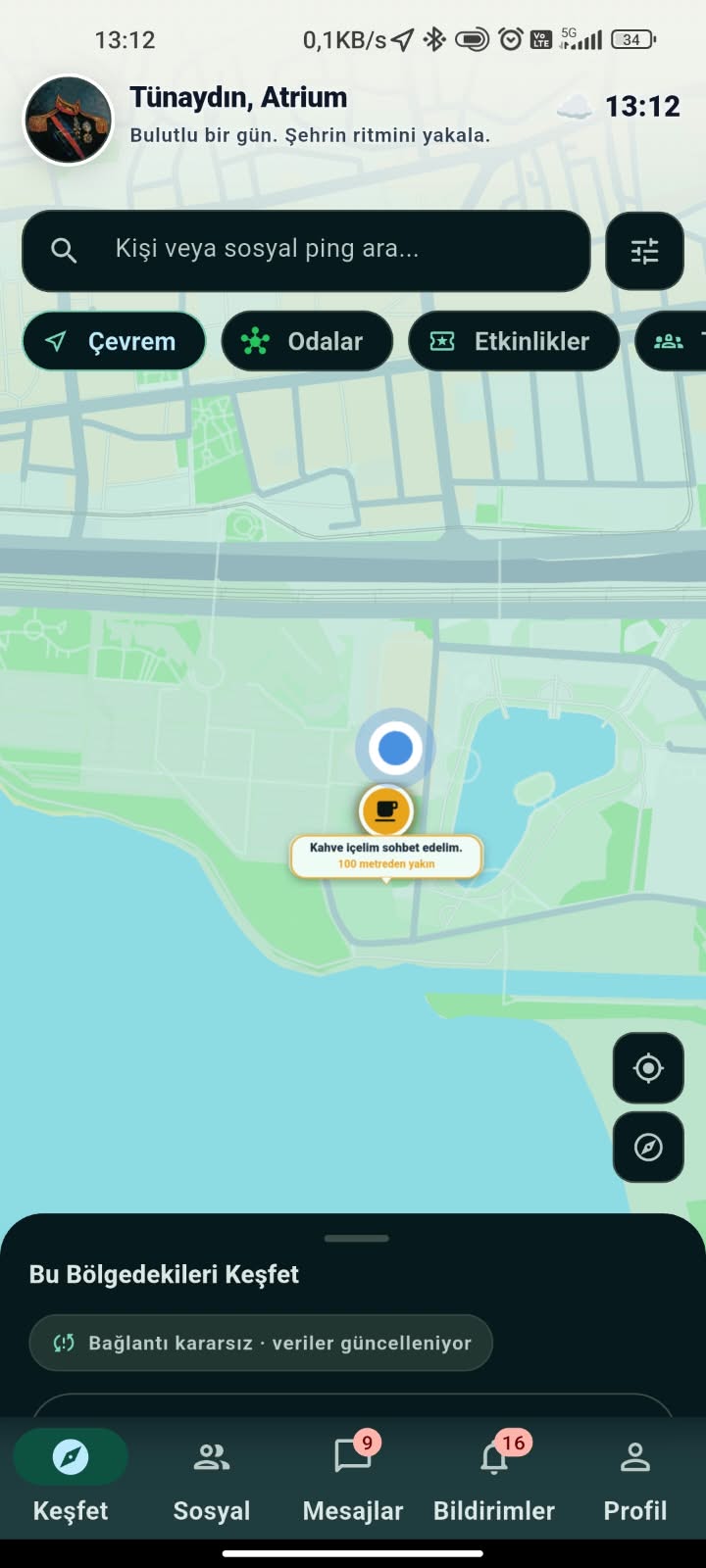
Your daily travel habits also shape what nearby means. A walkable area and a trip across the city imply different time commitments. The neighbourhood scene explains layers without requesting location access. It does not read GPS data or generate real distances and live users. The MVP capture shows the actual application interface.
04
What should you look for after opening a marker?
An event calls for its date, venue and organizer; a business needs hours, address and services; a community needs a shared purpose and participation context. People and Pings require attention to communication choices. Each marker should lead into its own module rather than an identical generic detail card.
Avoid filling missing information with assumptions. Before an in-person plan, review conditions, travel and whether details are current. Map visibility does not automatically certify a person, place or event. Atrium Trust explains privacy and communication choices as part of that decision.
05
A Saturday morning in a new neighbourhood.
Imagine moving to a new neighbourhood and enjoying photography. You explore a photography community, then review its walk's time and meeting point in event details. A nearby café may offer somewhere to sit afterwards. Three layers support one possible outing, while the decision remains yours.
The exploration does not have to end in attendance. The group may not suit you, the time may clash or you may simply want to understand the area. This illustrative scenario explains how map and detail views can support a journey; it is not a record of an Atrium event or verified attendance.
06
A person's location is not a business address.
A business may publish an address so people can visit. Discovering a person does not require exposing their home or daily route. Approximate location starts with this distinction: personal visibility and a public venue address are different design decisions. Connecting nearby does not confer a right to track someone.
Being visible, allowing contact and choosing to go somewhere are separate choices. People should understand each consequence. Development examines both discovery value and whether privacy choices are understandable. The safety page distinguishes current interfaces, design principles and controls still being developed.
07
We will not fill an empty map with invented activity.
A local network needs relevant options in the same area. A national account count does not guarantee useful results in one neighbourhood. The micro-region approach tests whether people, communities, events and businesses can create value together in a focused setting.
Lights and cards in the web scene are not evidence of local density. Controlled beta needs real learning about relevance and repeat use. Planned measurements distinguish discovery, communication and physical participation. The research page explains what will be measured without presenting invented success rates.
08
Today's interface and the next learning questions.
The Nearby map and social discovery interface appear in the MVP captures. A shared discovery language is the current product direction. Contextual ranking, explanations and quality at different density levels require further development and pilot learning. An existing interface and a long-term research objective should remain distinct.
Review the real capture alongside the interactive scene, then follow the relevant module: Ping for a small intention, Events for a scheduled plan and Communities for recurring interests. Contact is the real next step for discussing participation or a pilot today.
09
Think about discovery at the scale of your day.
The current model defines search radii of 100, 500, 1,000 and 5,000 metres. Different scales support an immediate area, walking context or wider local exploration. Few results in a small area may reflect limited supply rather than an error; a wider area makes travel and timing more relevant. The largest radius is not necessarily the best choice.
Location permission, search bounds and personal location shown to others are separate concerns. Selecting a radius should not imply public disclosure of a precise GPS point. The web scene explains the idea without performing live radius-based searches.
10
Read the map in three passes.
First understand the kinds of options shown. Then choose a layer for your question: a plan today, an ongoing circle or a venue. Finally inspect one object. This sequence reveals information without forcing every detail onto the map, and the module detail carries the decision forward.
An activity, its community and its venue provide different information rather than three copies of one object. Dates, common purpose and practical location belong to different contexts. Moving between their details preserves those differences and allows exploration at a personal pace.
11
Three different needs in one area.
Someone with half an hour after work may prefer a small intention; a new hobby may call for a recurring community; a visitor may seek one activity with clear travel information. The same location can lead to different discovery needs.
Consider available time, one-off versus ongoing involvement, and digital versus physical participation. Those preferences can change. Switching filters or going back is ordinary discovery behaviour, and an initial choice should not become an obligation.
12
Close does not always mean accessible.
Distance is only one part of reaching a venue. Routes, transport, costs and personal needs also matter. A short map distance should not imply guaranteed accessibility. Review details and ask the organizer or venue about missing information; automatic verification of every access condition is not claimed.
A busier place is not automatically a better fit. Some people prefer smaller groups or clearer programmes. Pilot learning should examine understandable, sufficient information alongside the quantity of options rather than treating visual density as success.
ABOUT THIS MODULE
A few useful answers.
Does this page use my location?
No. The illustrative web scene does not request location access.
Can I message everyone on the map?
Being discoverable is different from permitting contact. The communication flow and the other person's choices still matter.
THE NEXT STEP
Be part of the life around you.
Start a connectionWorking MVP · Preparing for controlled beta · Contact us about participation and collaboration.