People
We may share interests. We may be on the same campus or in the same neighbourhood. Yet we may never meet.
Atrium brings users, communities, events and businesses in the same physical surroundings into one spatial network, aiming to turn digital discovery into real-world interaction.
 ATRIUM
Conceptual network — not a live map or user data.
Events are in one place, people in another, communities somewhere else and businesses elsewhere. Atrium aims to connect these parts within a single local graph to generate more meaningful discovery, stronger social connections and measurable physical action.
Today's digital platforms connect us globally. Yet people, communities, businesses and opportunities in the same physical surroundings often cannot discover one another.
Atrium treats this disconnect as a local network problem, rather than a content problem.
We may share interests. We may be on the same campus or in the same neighbourhood. Yet we may never meet.
People look for communities. Communities struggle to reach the right people.
Hundreds of things happen in our city. We hear about many only after they are over.
Local businesses see potential customers around them, but cannot reach the right audience at the right time.
Atrium brings different kinds of local activity into the same network instead of splitting them across separate apps.
Not five separate apps.
Different parts of the same local network.
Discover nearby people with shared interests, skills or goals.
See social activity happening or starting around you right now.
Discover nearby events, from concerts and workshops to community meetups and sports.
Find local communities that share your interests, join them and take action together.
Discover nearby places, offers, events and local opportunities.
Atrium was developed as more than a concept or presentation. Much of the B2C discovery experience, map-based local network, communities, messaging, events, business management and safety infrastructure has been built in a working MVP.
The current goal is to make this system reliable and measurable enough for pilot use, rather than simply adding more features.
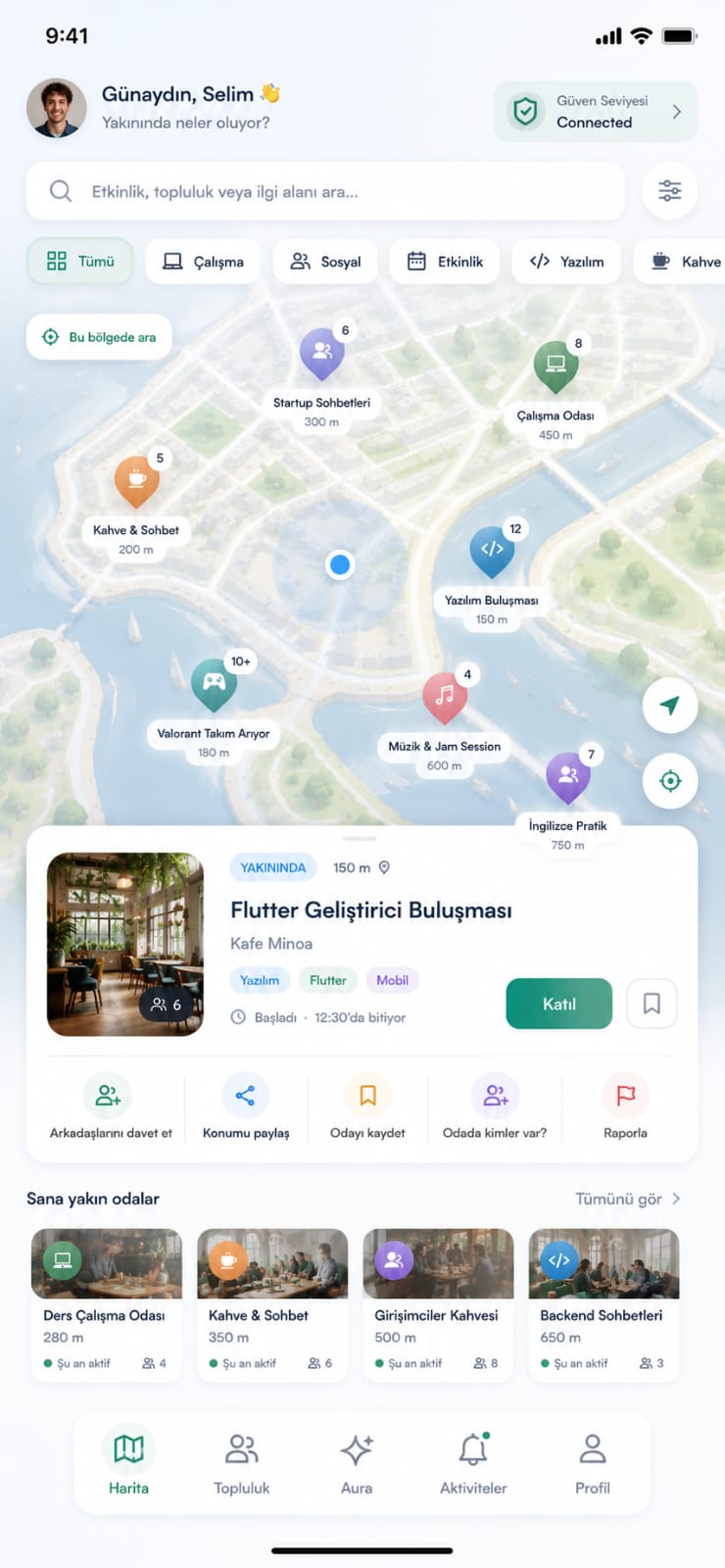
Discover nearby rooms and meetups.
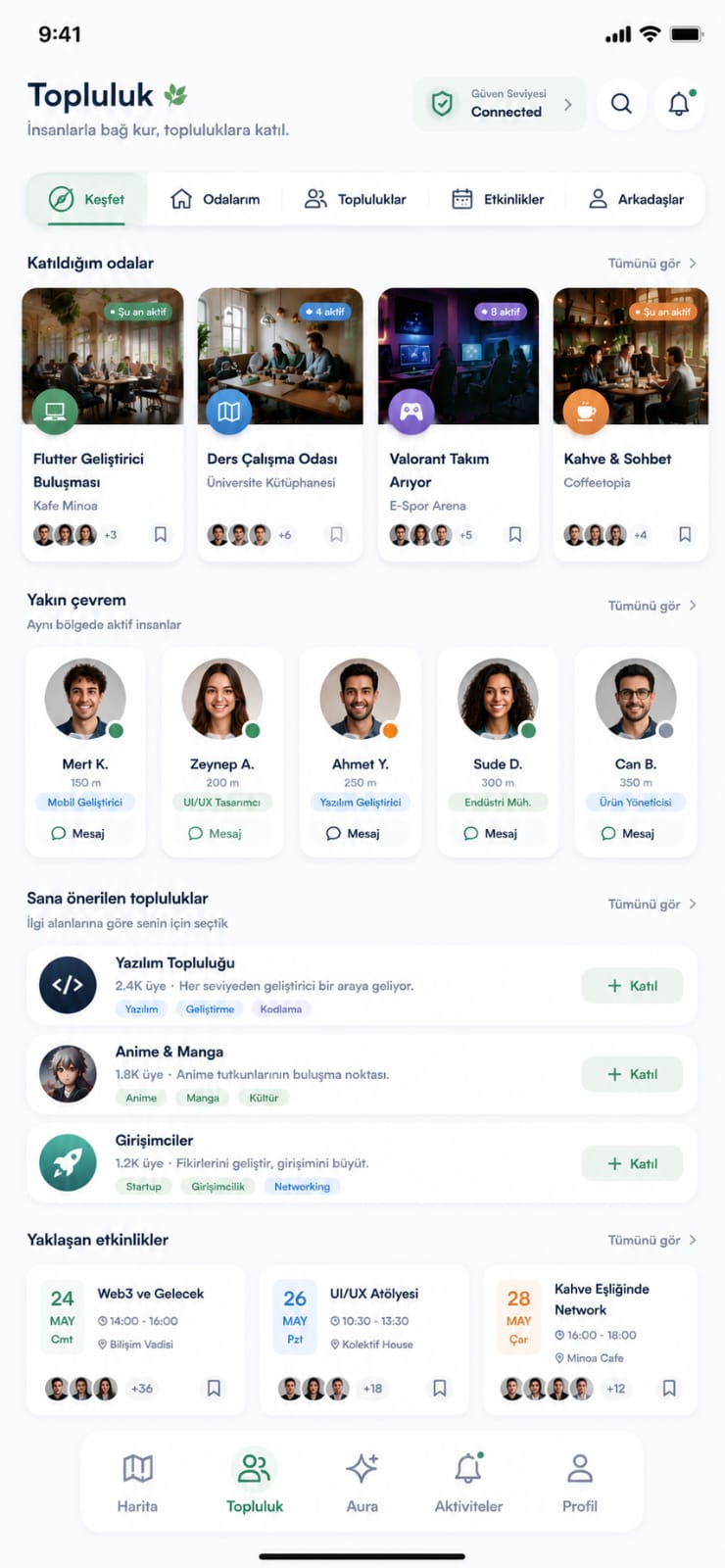
Rooms, communities and upcoming events.
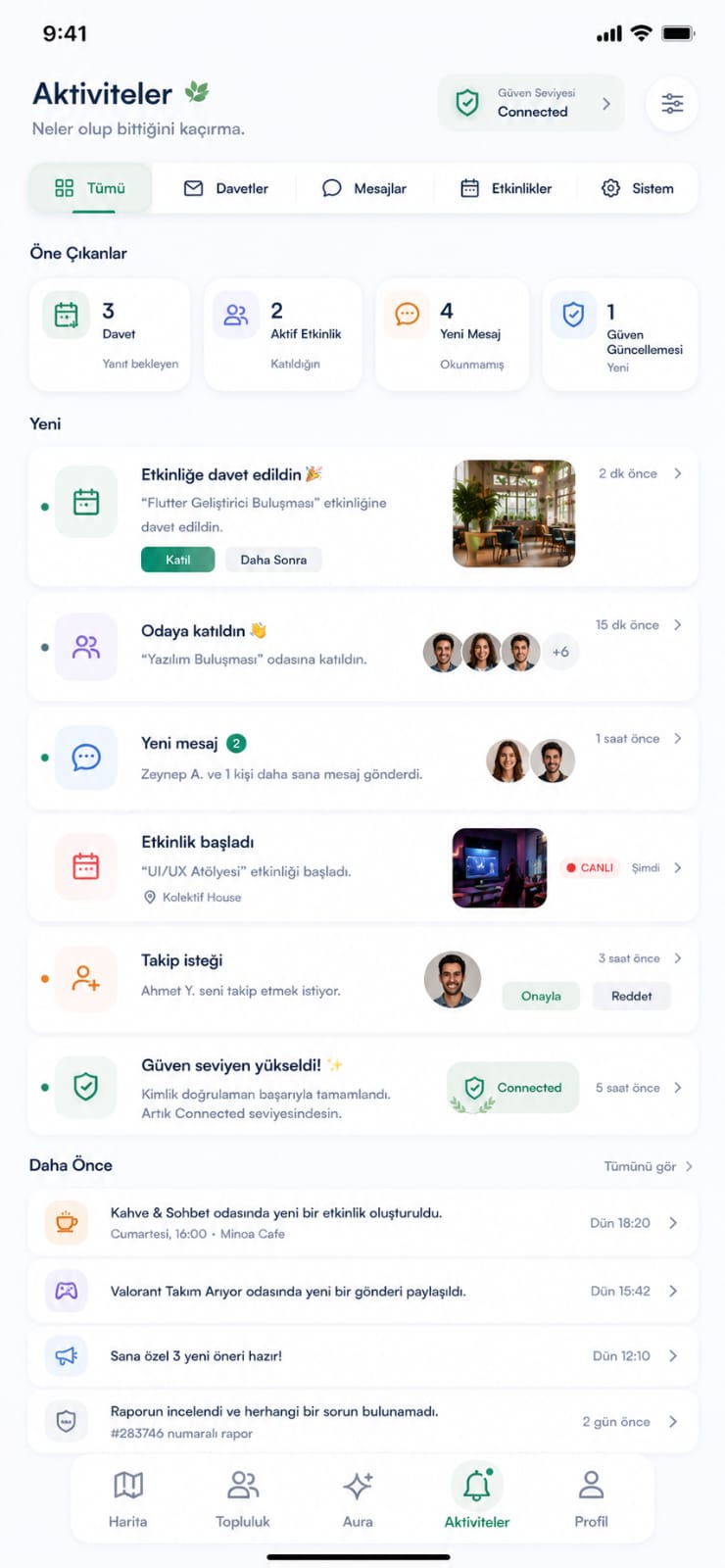
Follow invitations and interactions in one place.
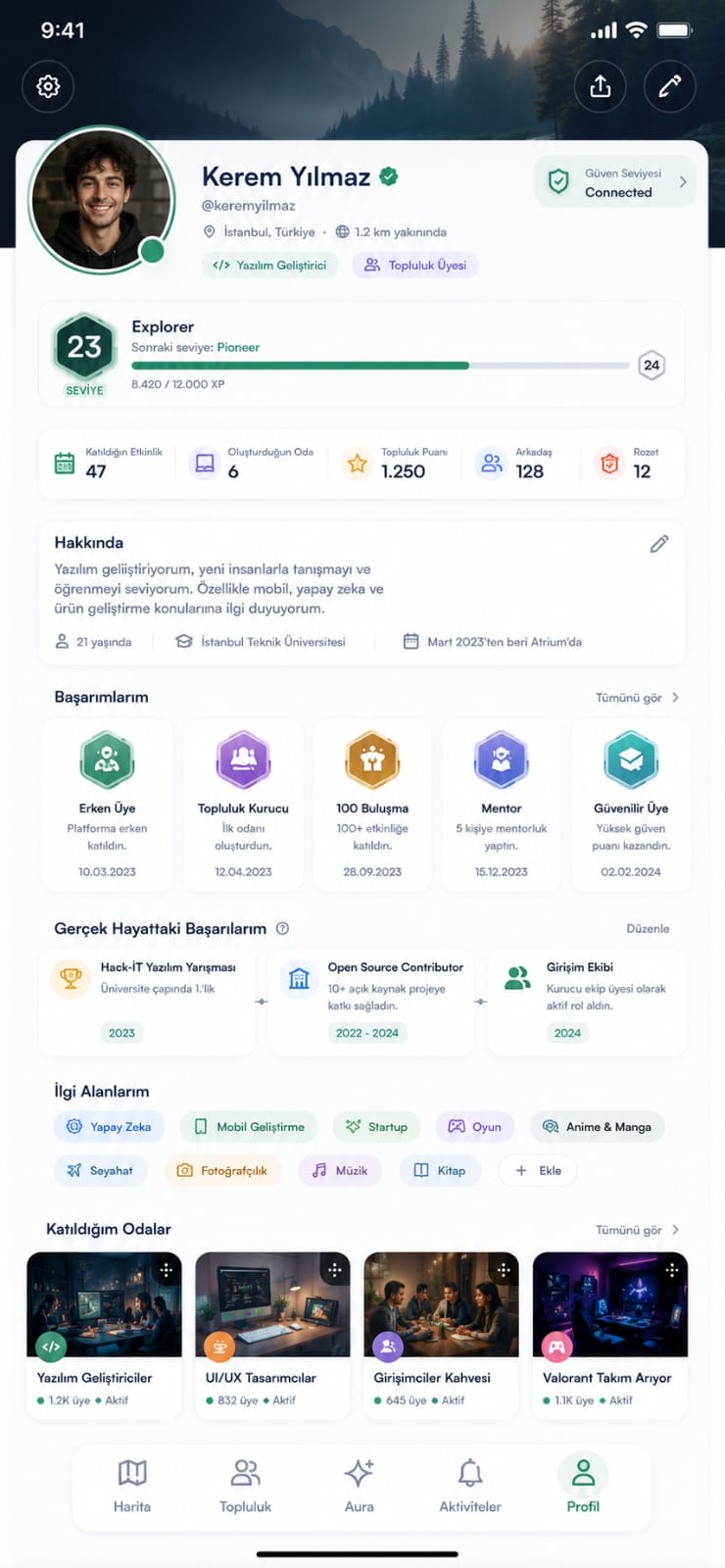
Bring interests and community identity together.
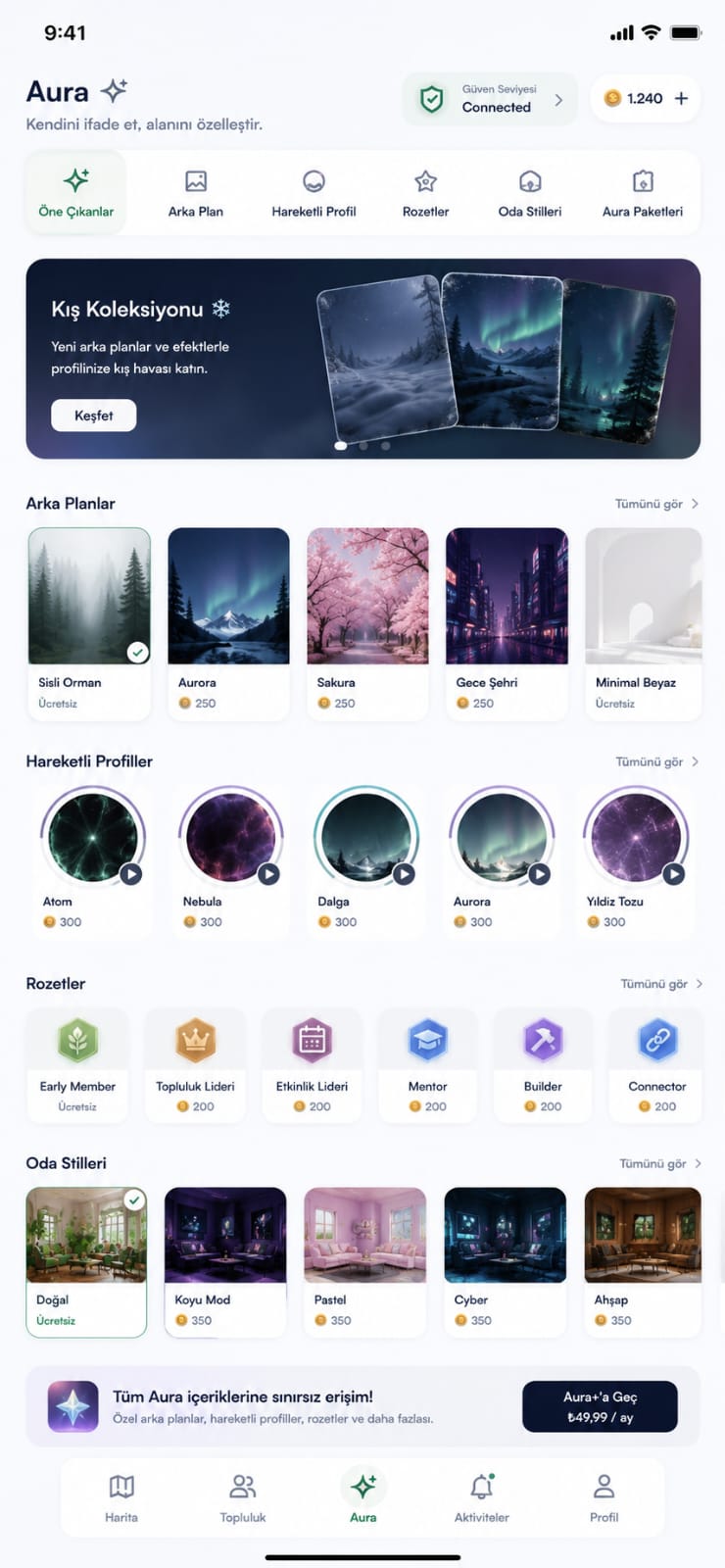
A visual experience designed for personalization.
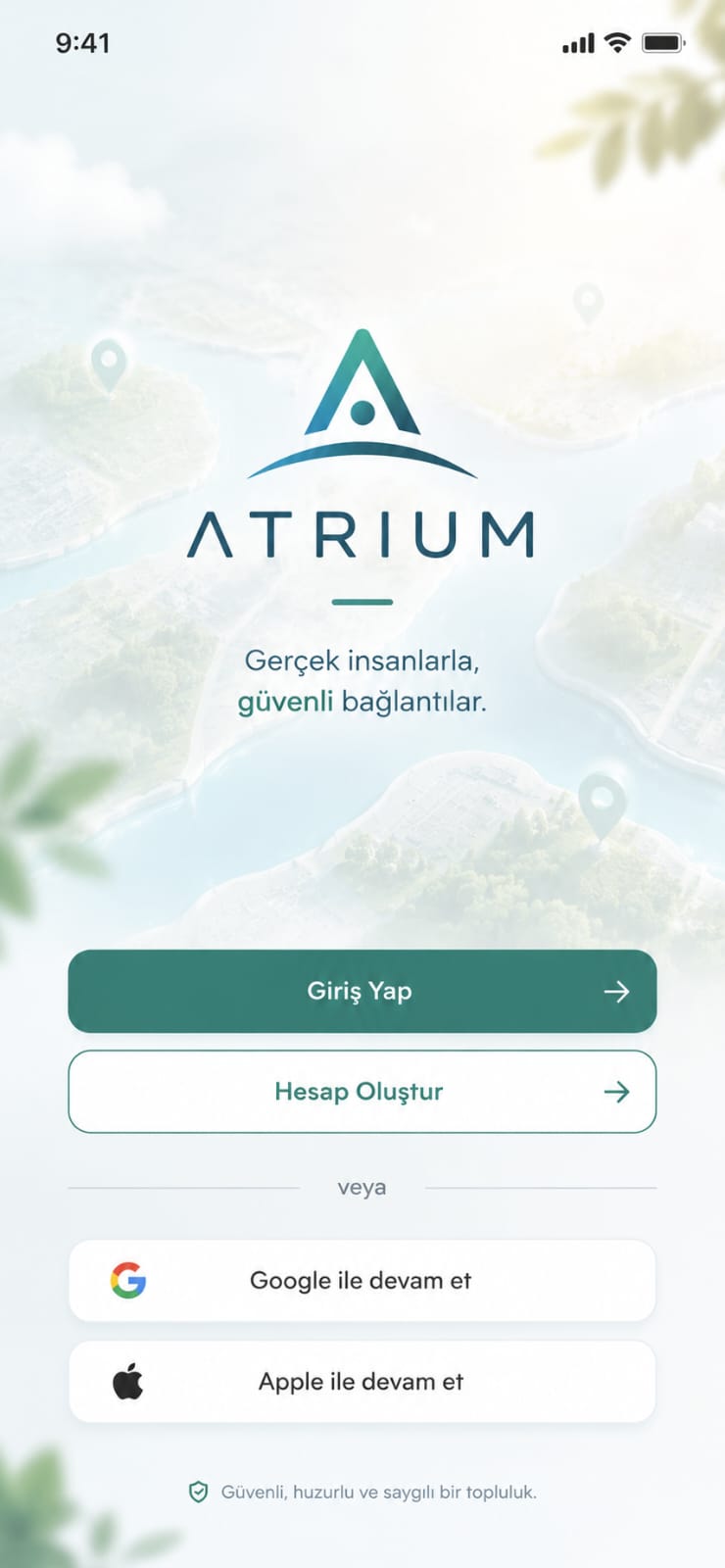
The first step into Atrium.
Atrium prototype screens. Design and illustrated features may change during development.
Many new products have emerged around event discovery, matching gamers, finding communities, local business visibility and meeting new people.
We interpret this as different parts of the same broad need being discovered independently, rather than a single competitor category.
Atrium's thesis is to connect these questions within the same local graph, rather than solve each in isolation.
Atrium is still in development before closed beta. We do not yet have large-scale market data or proof of product-market fit. We are conducting early user interviews to shape product decisions.
Atrium early user research
Virtual Atrium / Rooms early user research
The strongest signal was more than interest.
Many users repeated the same two conditions: sufficient local density and trust.
This is early qualitative user research. It should not be treated as representative or statistical market research.
Early interviews with different user profiles revealed recurring themes around local discovery, social media fatigue, safety, finding communities and local density.
Found the Atrium idea compelling, especially expressing fatigue with the current social media experience.
Liked the idea, but considered safety and trust mechanisms critical for physical interaction with strangers.
Said they wanted to use Atrium when it launched, particularly highlighting niche and local community discovery.
Liked the idea, but questioned how quickly Atrium would reach their cities or regions.
Were particularly interested in pricing and the free/paid usage model.
Said local socialising and community discovery did not appeal to them.
Did not express a clear view.
The strongest signal was more than interest.
Many users repeated the same two conditions: sufficient local density and trust.
This is early qualitative user research. It should not be treated as representative or statistical market research.
Source: the supplied Atrium research summary. Interview dates, recruitment methods and raw interview records were not supplied.
173 + 67 + 32 + 14 + 7 + 5 + 2 = 300
Many users who tested the Rooms idea responded positively to finding nearby people who share games or digital interests.
Showed strong interest in finding nearby people who play the same games or share digital interests.
Said they liked the idea and could use such a feature.
Said similar social platforms had become empty due to user and trust problems, and they would use Atrium if it overcame them.
Did not see themselves as target users because they had no need for gaming or virtual friendship.
Supported the idea, but warned about empty rooms or maps if sufficient user density did not form.
Did not express a clear view.
Interest was strong. The condition was the same.
Social features alone are not enough without density and trust. Rooms are therefore designed as a layer connected to Atrium's physical network, rather than a separate chat product.
This is early qualitative user research. It should not be treated as representative or statistical market research.
Source: the supplied Atrium research summary. Interview dates, recruitment methods and raw interview records were not supplied.
85 + 15 + 8 + 4 + 3 + 2 = 117
We aim to make invisible connections between nearby people, communities, events, businesses and opportunities visible, helping digital discovery become physical action.
Measurements differ; countries cannot be compared directly. Atrium is not a healthcare or therapy solution. These data do not prove Atrium's impact, user demand or product-market fit.
People reporting loneliness
A pooled research estimate, rather than a single 2025 survey. Loneliness is a subjective experience.
WHO ↗Often or always lonely
Direct frequency question. Random sample of 20,000; 59.4% response. UCLA scores and social isolation are measured separately.
Cabinet Office Japan ↗Feeling somewhat or very lonely
Different question wording. OECD explicitly says it cannot be directly compared with its other-country average. Youth withdrawal is a separate policy issue.
OECD ↗Lonely most or all of the past four weeks
Non-probability online consumer panel. 35% were lonely at least some of the time; the 13% is within that broader group. The figures are not added. We do not rank countries.
European Commission / JRC ↗Often or always lonely
Direct question; no significant change from the previous year. CES totals over 175,000 responses; the loneliness subsample is not assumed to equal that total. Community questions: October 2025–March 2026.
UK Government / DCMS ↗One-person households — not a loneliness rate
Ministry document citing TurkStat data. Household structure and subjective loneliness are different measures. Living alone does not mean feeling lonely.
Aile ve Sosyal Hizmetler Bakanlığı; TÜİK kaynaklı ↗It considers the whole local network, rather than leading with events or people alone.
It does not place precise user location at the centre of the social product.
It aims to measure success through real-world behaviour as well as views and interactions.
It targets local network density rather than dispersed growth.
Atrium aims to produce more meaningful local discovery within a user's context, rather than simply show the closest thing.
Where?
When?
With whom, and around which interests?
What's happening in the area right now?
Distance alone does not create meaningful discovery. Atrium is researching how distance, time, community context and physical activity signals can be considered together.
We are working on dynamic spatial privacy methods that reduce exposure of precise user locations while preserving location utility.
We are researching ways to measure whether digital discovery turns into physical action without relying on a single GPS signal.
We aim to vary the information shown and permissions granted according to identity verification level, behavioural trust and interaction context.
Compare a distance-based control with context-based ranking in a pilot.
MEASUREMENTMeaningful discovery and physical action per eligible session, considering cohort and regional supply.
Evaluate different levels of spatial precision in controlled scenarios.
MEASUREMENTDiscovery utility and re-identification risk, with separate tests for sparse regions.
Compare GPS-only verification with user consent and additional physical signals.
MEASUREMENTFalse positives / negatives and data minimisation; measure verification quality without sharing raw location.
Design progressive permissions experiments by task and risk context.
MEASUREMENTReviewed abuse incidents alongside legitimate interaction and verification friction.
We do not claim these hypotheses are already proven. Atrium's R&D approach is to measure them with pilot data.
In Atrium, safety is more than a report button or a privacy policy. Identity, visibility, location and the level of interaction people can have are parts of the product architecture.
No social platform can eliminate every risk in the physical world. Atrium aims to reduce risks where possible, make abuse harder and give users control, rather than hide the risks.
Discover Atrium.
Explore general local activity, businesses, events and privacy-safe density information.
Move towards social interaction.
Access controlled connection requests and selected social features.
Access physical features that require higher trust.
Ping, physical meetups, nearby people discovery and similar higher-risk features may require a higher trust level.
Identity verification does not mean that a person is safe. It only means that the identity of the person behind the account has been verified.
Explore the trust architectureDiscovers meaningful people, communities, events and businesses nearby.
Reaches the right members, participants and physical activity.
Gains local visibility, physical visits and privacy-safe performance insights.
Atrium's network effect relies on three sides of a local ecosystem supporting one another, rather than a single user group.
For local businesses, the challenge is more than being visible online: it is reaching the right people who are genuinely nearby, at the right time.
Business profile, address, opening hours, menu/catalogue and basic visibility.
Local offers, events, advanced CTAs and stronger community interaction tools.
Advanced hyperlocal campaigns, privacy-safe performance measurement and physical action analytics.
Package structure may change based on beta and pilot findings.
For local network products, total user count alone is not meaningful. 100,000 users hundreds of kilometres apart may create less value than a few thousand active users who can reach one another in the same area.
A limited geography.
Enough users, communities, events and business supply.
Continuous local activity that brings users back.
Digital discovery becoming real-world behaviour.
Building the same model in a second region.
Density before reach.
Total user/download scale reached in previous mobile product experience.
Operational experience at a monthly active user scale in a live digital product.
Experience with live users, monetisation, support, product development and operations.
Atrium is a new venture. These figures are not Atrium traction; they describe the founding team's previous product development and live system operations experience.
Atrium's success will be measured by whether the local network really works, rather than its feature count.
Atrium is moving from MVP to a pilot-ready product. At this stage, we are looking for mentorship, R&D validation, pilot collaborations, community and business partners, and relationships that help strengthen the team.
Selim Azizi · Founder, Simurg Interactive
Contact through Simurg Interactive's official website.