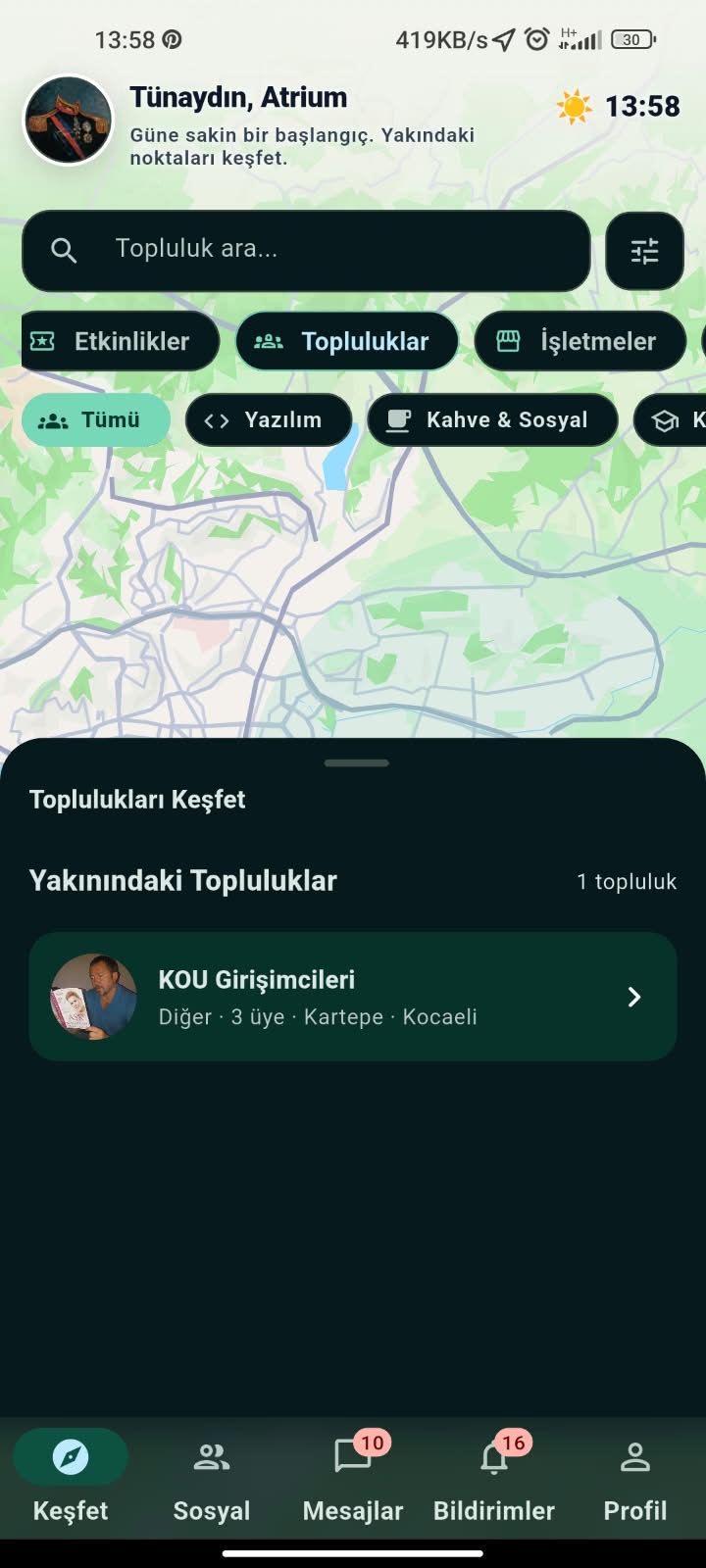
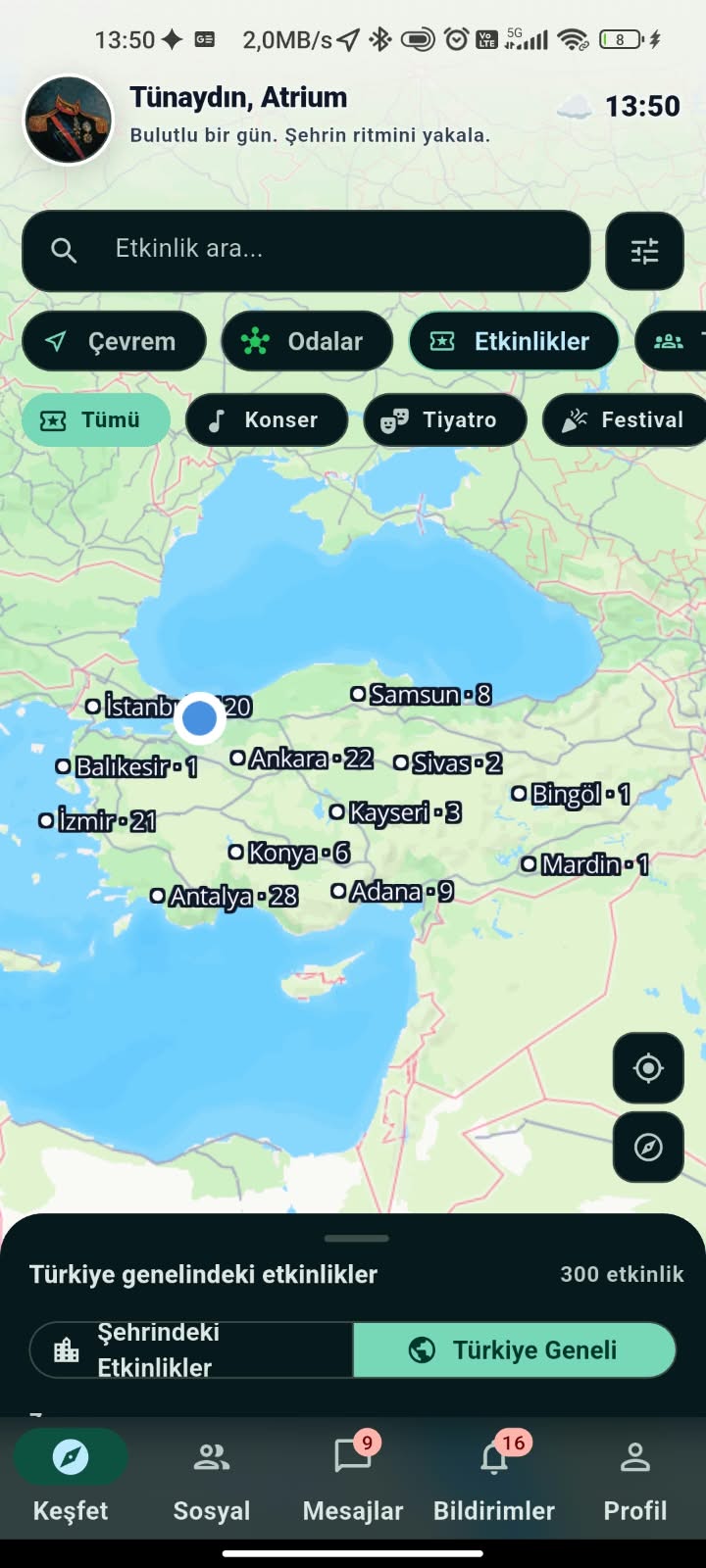
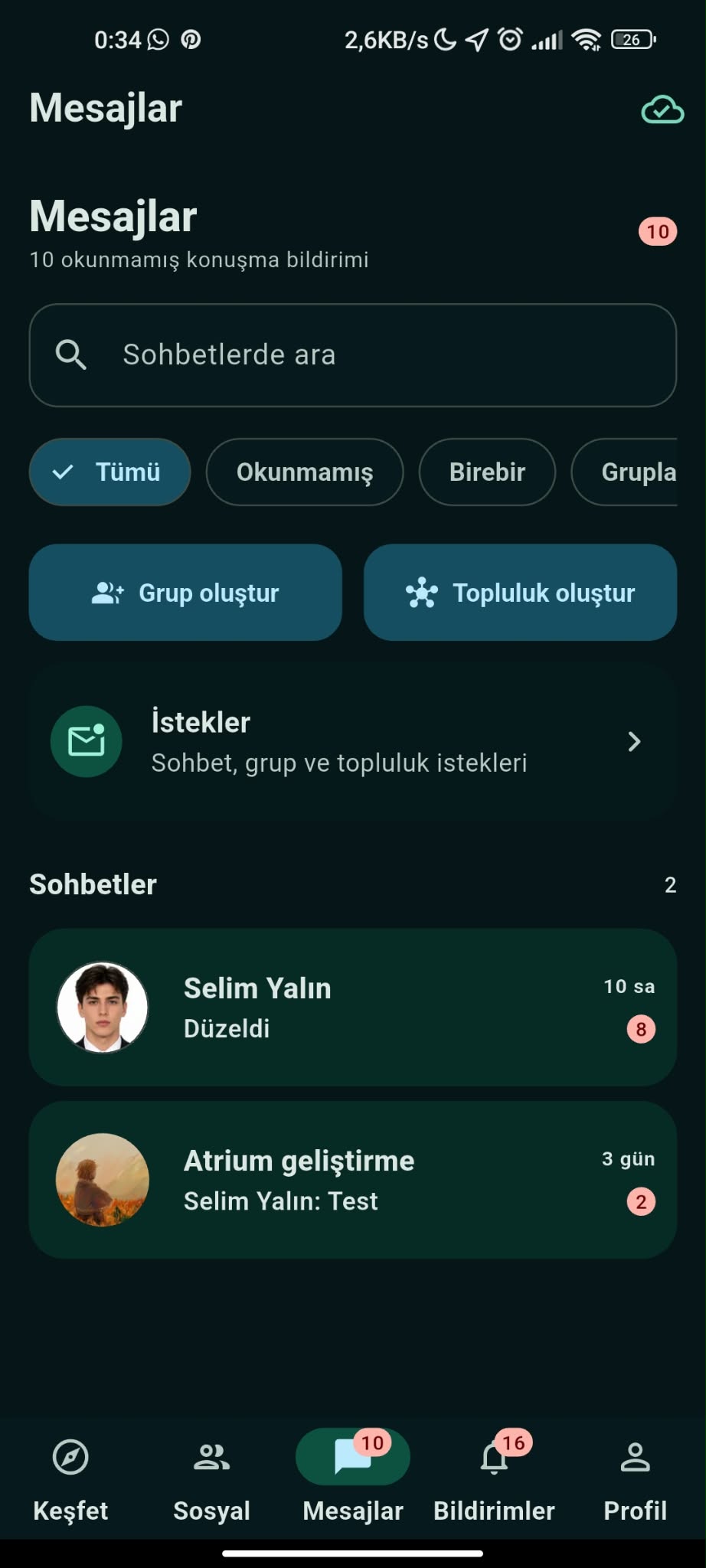
Atrium is about more than dots on a screen: people and possibilities discovering one another in a useful context. Choosing to meet remains a personal decision.
A COMMUNITY’S JOURNEY
The first gathering starts the next.
01 / 03 INSIDE THE PRODUCT
Real MVP screens · Demo content01
Introduce your community, its interests and its local context.
Newcomers need to understand the group's purpose and first step. Membership, invitations and management differ. Choose a concrete pilot task before considering changes to existing channels.
02
Bring the time and place of your gathering to people discovering your community.
Time, venue, preparation and expectations matter alongside a title. Event and community context support the decision together, while operations remain the organizer's responsibility.
03
Build the beginning of the next gathering through community conversations and messaging.
Shared topics, communication and future activities can support continuity without guaranteeing return. A pilot can reveal missing information and where management needs support.
THE NEXT GATHERING
A community is more
than meeting once.
Atrium connects discovery, events and communication in one local context. We want to develop support for recurring gatherings together with pilot communities.
Organizer tools and pilot approach11 sections in this guide
01
Offer new participants a starting point, not only an announcement.
A group may have followers while remaining unknown to relevant people nearby. Seeing an announcement differs from choosing a first visit. Atrium connects a community introduction, event context and local discovery so prospective participants understand what joining would mean.
The aim is not to force an existing audience to move. A pilot should choose a concrete problem: reaching newcomers, explaining activities or supporting continuity. Existing channels may continue while the product's contribution is evaluated.
02
Before the event: make expectations clear.
Purpose, time, venue and conditions belong together. A first-time participant should understand suitability, preparation and where to ask questions. Source includes community-event drafts and creation flows, supporting preparation without replacing the organizer's responsibilities.
Clear information may reduce repeated questions, but this needs pilot evaluation rather than a promised workload reduction. Venue, capacity and freshness still matter. Workshops, walks and digital gatherings require different explanations.
03
Examine participation from a newcomer's perspective.
A newcomer discovers the community, reads its purpose and reviews an event. Any membership or invitation requirement should be understandable. Source includes invitations, acceptance/rejection and membership management, providing a clearer context than an unexplained group-chat link.
Interest or a joining request does not prove attendance. Organizers need to understand what each number represents. Discovery, applications, communication and physical participation should be measured separately, without presenting demo values as results.
04
The community continues after the gathering.
Participants may want to discuss the next book, walk or workshop. Community communication and future activities can support continuity, but purpose, quality and ongoing management still matter. Atrium does not promise to build a community automatically.
A pilot can examine confusing information, communication workload and newcomers' needs. Unverified automatic recurrence or extensive analytics should not be presented as completed tools; current scope and future support remain distinct.
05
Venue partnerships start with a suitable context.
A café may suit a book gathering; a workshop may suit a small group. Both parties need to understand facilities and requirements. Atrium connects these contexts without automatically completing reservations, pricing or operational agreements.
A specific pilot activity makes contribution easier to examine: did discovery reach someone new, improve information access or simply reveal an existing connection? These answers require real learning. Businesses and organizers complement one another while needing different product explanations.
06
Community trust needs active responsibility.
Roles, rules, communication and handling concerns shape the experience. Source includes role assignment and member management, which require appropriate server enforcement. A management interface alone does not establish safe operations; pilot responsibilities should be agreed beforehand.
Stopping an unsuitable interaction matters as much as reaching newcomers. Membership does not imply unlimited direct-contact permission. Atrium Trust explains boundaries. A pilot discussion can begin with the group's context, expected value and operating capacity.
07
Organizers help keep a local network active.
Running an event and sustaining a community involve different kinds of work. The organizer role brings together a shared-interest circle, event information and participant communication. It is distinct from a business role: an organizer does not need to own a venue.
The MVP contains community and event flows. Membership, invitations and administrative permissions matter beyond creating a listing. An organizer's authority should remain within its context; convenience should not expose participants' private information without limits.
08
Reach relevant people, rather than everyone.
Someone looking for a nearby reading group, walk or workshop may not know you yet. Local discovery explores whether an appropriate context can connect you with people beyond existing followers. It does not guarantee reach or attendance.
Clear information about who an event is for, when and where it happens and its conditions comes first. Understanding detail views, questions and returning participants may be more useful than an ambiguous reach figure. We want to define valuable signals together in the pilot.
09
What makes a second gathering possible?
Interest in one event does not establish a recurring community. Members need to hear about the next plan, communication needs continuity and administrative work must stay manageable. Communities and Rooms aim to support that continuity; the effect has not yet been validated in a pilot.
The final scope of recurring-event tools, notifications and organizer services will be evaluated through feedback. Ticketing, payments and organizer earnings are not guaranteed outcomes today. We want to understand real workflows before multiplying tools.
10
Communities and venues can intersect.
A board-game group may need a recurring meeting place while a café wants to use quiet hours. This illustrative scenario does not assume organizers and businesses have identical needs. Venue suitability, accessibility, capacity and conditions require a separate agreement between them.
Atrium aims to make these possibilities discoverable. It does not assume a commercial agreement, reservation or physical safety is automatically provided. The pilot needs to learn which connections help and where the platform needs additional responsibilities.
11
The pilot starts with your everyday work.
Tell us about your community, activity frequency and current announcement channels. Is finding new participants, communicating with members or reducing administration your main need? Defining the pilot around that question is more useful than offering the same toolset to every organizer.
Participation quality, recurring gatherings and organizer time can be evaluated together. Feedback should change assumptions that do not work, rather than simply collect approval. No fixed pilot date or quota is announced yet.
COMMON QUESTIONS
Clarity for your community.
Must I move my existing community?
A pilot need not move all communication. Choose a concrete task first: reaching newcomers, explaining an activity or supporting continuity. Existing channels can be considered within that scope.
Who runs the event?
The organizer remains responsible for programme, information and operations. Atrium aims to connect that context to discovery. A demo is not an event-management service or attendance record.
Do members and managers have identical permissions?
No. Membership, invitations, roles and management differ. Source includes role assignment and member management; server enforcement and application validation remain necessary.
What should I bring to a pilot discussion?
Purpose, area, activity type, management responsibility and a concrete need are useful. User counts are not mandatory; begin with context and expected value rather than personal data.
 ATRIUM